

About Behavioral Outbreak Sentinel Surveillance (BOSS)

BOSS is a rapid digital behavioral surveillance platform deployed across multiple urban sentinel cities via Facebook and Instagram targeting. Approximately 200 respondents per city per week complete a 20-question pulse survey covering four tracking domains: awareness diffusion, behavioral disruption, information environment, and underlying concerns driving behavior change. Surveys are administered in English and French. ABSN Champions — practitioners trained through the Africa Behavioral Science Network across 25 countries — are embedded in the interpretation loop after each wave, providing on-the-ground context for quantitative findings. The instrument is adapted on a rolling basis as data signals evolve.

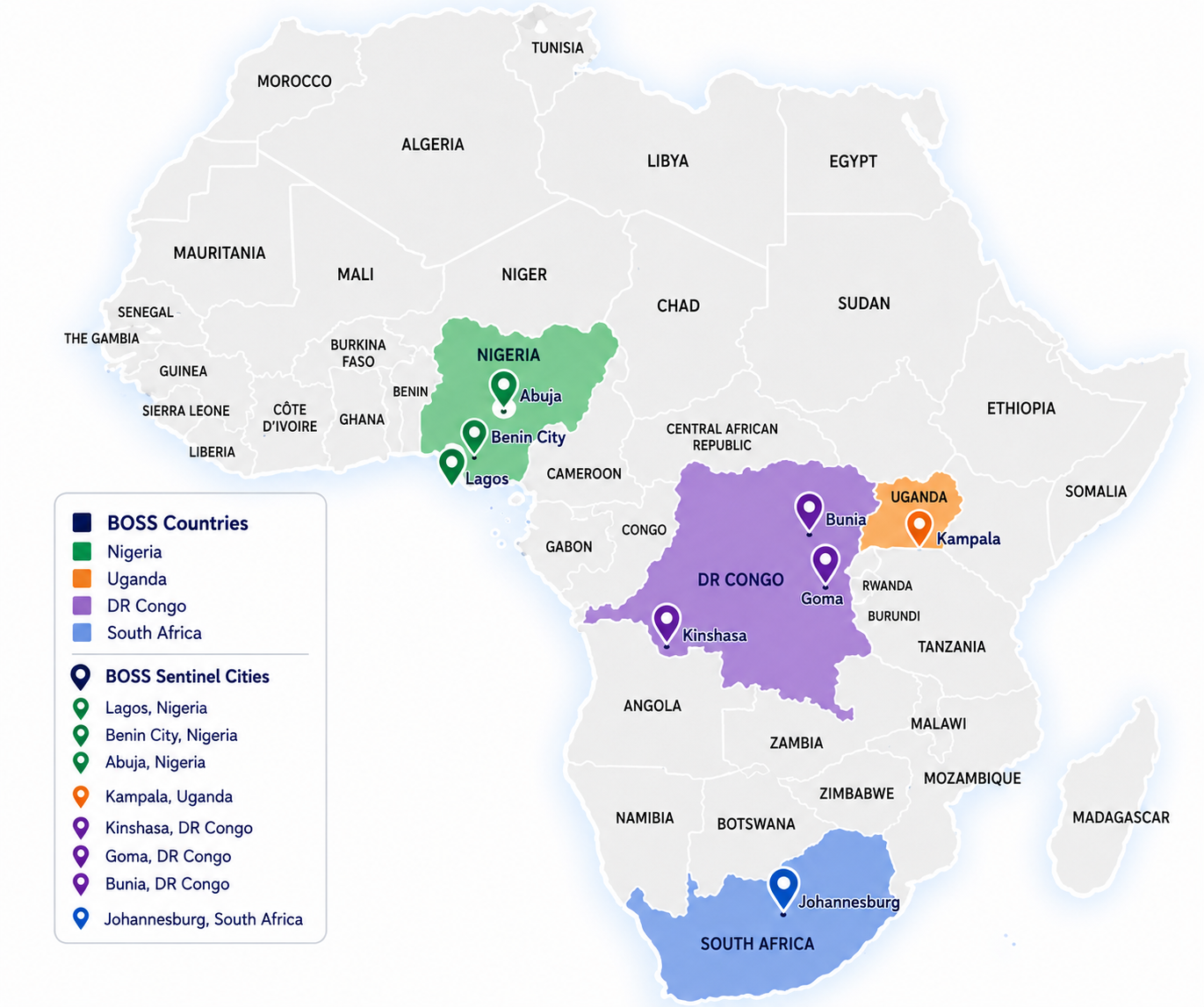
Current sentinel cities: Lagos, Abuja, Benin City (Nigeria) · Kampala (Uganda) · Kinshasa, Goma (DRC) · Johannesburg (South Africa)

EXPERTISE

Map of BOSS Countries and Sentinel Cities

Please click on the map below to access all BOSS reports.
BOSS Reports

Please click on each report below to download it.

  • "The channel architecture of each city's information environment — the ratio of broadcast to social network reliance — is the structural variable that determines how much false information penetrates the population. This difference shapes everything that follows."

    —False Information BOSS Report

  • "Church attendance independently predicts worry even after controlling for how close Ebola is in the social network. The mosque and church are not merely information channels — they are settings where bodies are close, voices carry, and collective emotion is amplified."

    —Lagos BOSS Report

  • "Religious leaders in Kampala are relevant not because their settings are producing anxiety but because their settings are being watched. Modeling visible, normative protective behavior is the intervention — not delivering fear-based messaging to an already-worried congregation."

    —Kampala BOSS Report

  • "Johannesburg residents are mobile. Market and congregation attendance in this sample is high, though the economic structure of Johannesburg — with more formal employment than Lagos and a different informal economy — means that mobility constraints operate differently. Unlike Lagos, where not going to market is a livelihood decision most residents cannot afford to make, Johannesburg presents a more varied economic landscape."

    —Johannesburg BOSS Report